
 By Team Loandrone
VantageScore vs. FICO: How New Credit Score Changes Could Affect Homebuyers and Homeowners in 2026
For decades, mortgage lenders have relied heavily on traditional FICO credit scores when deciding whether a borrower qualifies for a home loan. But the credit scoring landscape is beginning to change, and that shift could have a meaningful impact in 2026 for both people buying a home and homeowners looking to refinance.
With the Federal Housing Finance Agency approving the use of newer scoring models like VantageScore 4.0 for certain mortgage loans backed by Fannie Mae and Freddie Mac, many consumers are asking an important question:
What is the difference between VantageScore and FICO, and could these changes help borrowers qualify more easily for a purchase loan or a refinance?
That question matters more than ever. Whether someone is trying to buy a first home, lower an interest rate, reduce a monthly payment, or access equity through a refinance, the credit score used in underwriting can directly affect the outcome.
Understanding how FICO and VantageScore work, why they differ, and how lenders may use them can help borrowers prepare more effectively for either a home purchase or a refinance.
What is the difference between VantageScore and FICO, and could these changes help borrowers qualify more easily for a purchase loan or a refinance?
That question matters more than ever. Whether someone is trying to buy their first home, lower their interest rate, reduce a monthly payment, or access equity through a refinance, the credit score used in underwriting can directly affect the outcome.
Understanding how FICO and VantageScore work, why they differ, and how lenders may use them can help borrowers prepare more effectively for a home purchase or refinance. While both scoring models aim to measure credit risk, they do not always reward the same borrower behavior in the same way
What Is a FICO Score?
The FICO Score was developed by Fair Isaac Corporation and has long been considered the standard in mortgage lending.
Most traditional mortgage lenders still rely heavily on FICO-based scoring models during underwriting for both home purchase loans and refinance transactions.
FICO scores are created using information from the three major credit bureaus:
- Experian
- Equifax
- TransUnion
Because each bureau may contain slightly different information, borrowers often have multiple FICO scores.
What Is VantageScore?
VantageScore Solutions was created by the three major credit bureaus as an alternative credit scoring model. Many free credit monitoring apps and banking platforms now provide consumers with their VantageScore rather than a FICO score. Like FICO, VantageScore generally ranges from 300 to 850. However, the scoring formulas are different, which means borrowers may see noticeably different numbers between the two systems.
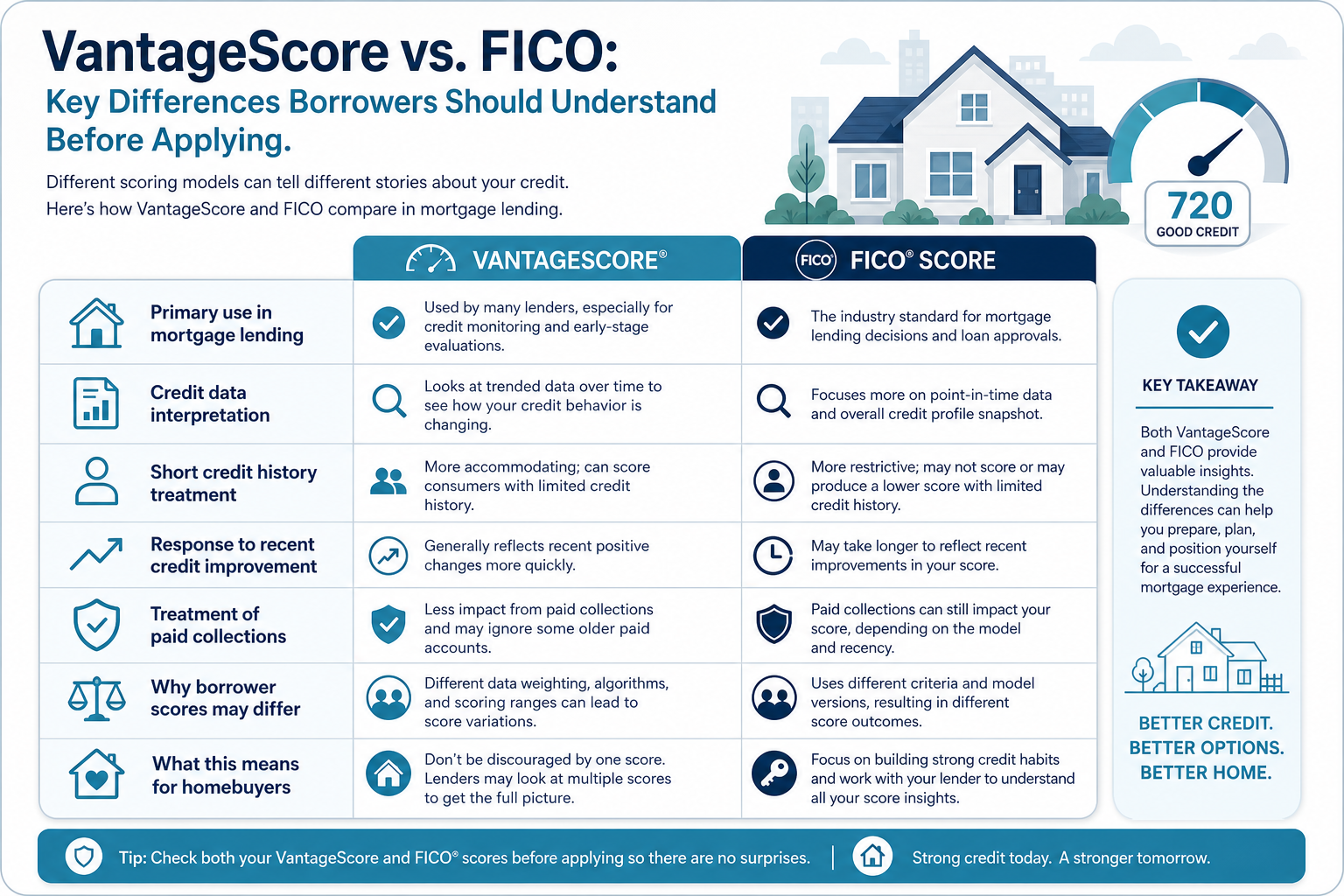
VantageScore vs. FICO: Key differences borrowers should understand before applying
A credit score is a numerical estimate of how likely a borrower is to repay debt responsibly. Lenders use it to evaluate risk when approving mortgages, credit cards, auto loans, and personal loans. Most scores range from 300 to 850, and in general, higher scores can help borrowers qualify for better loan terms and pricing.
That is why a borrower may have one score in a free credit monitoring app and a different score when a mortgage lender pulls credit. In many cases, the difference can be meaningful enough to affect approval, interest rate, mortgage insurance pricing, or down payment requirements.
Why Scores Can Differ So Much
Looking at the core factors behind credit scoring can help explain why two models may produce different results from the same credit file.
Typically a Consumer’s VantageScore is often slightly higher than their FICO Score, but not always. The difference depends on the person’s credit profile, the credit bureau data being used, and which version of each scoring model is being compared.
FHFA has explained that newer approved models such as VantageScore 4.0 and FICO 10T can incorporate additional payment history when available, including items such as rent, utilities, and telecom payments. FHFA also states that these newer models may score more consumers and may provide a more predictive view of default risk
Although both models are designed to measure credit risk, they weigh certain behaviors differently. FICO traditionally places strong emphasis on payment history, credit utilization, length of credit history, new inquiries, and credit mix. VantageScore looks at many of the same factors, but its model can respond differently depending on the borrower’s profile.
For example, VantageScore may be more favorable for consumers with shorter credit histories, recent positive improvements, or paid collections. In some cases, VantageScore can generate a score with less historical data than FICO requires. That may benefit first-time buyers, younger borrowers, or consumers who are rebuilding credit.
VantageScore may also respond more quickly when a borrower pays down balances, lowers credit utilization, or establishes more recent on-time payments. On the other hand, FICO may be stronger for borrowers with longer-established credit, older active accounts, and steady long-term account management. Neither score is automatically better. They are simply measuring risk through slightly different formulas.
Why This Matters for Mortgage Borrowers
The FHFA, which oversees Fannie Mae and Freddie Mac, approved the use of VantageScore 4.0 alongside newer FICO models for certain mortgage loans. This change is designed to modernize mortgage underwriting and potentially expand access to credit. According to the FHFA, newer scoring models may:
- increase competition in credit scoring
- improve risk assessment accuracy
- include more borrowers with limited credit histories
- expand access to homeownership opportunities
Importantly, this change has the potential to influence all major mortgage activities, including both purchase transactions and refinance transactions. In other words, the effect is not limited to people buying a home for the first time. It may also matter for existing homeowners trying to improve loan terms or use equity more effectively. This is a key point: the score model used can influence both the ability to buy and the ability to refinance.
Could This Be a Real Benefit for Consumers?
For many borrowers, it could be. Consumers with limited credit history may benefit from models that can evaluate them more fully. For example: Someone rebuilding credit or newer to credit may see: FICO: 660 VantageScore: 690. Borrowers recovering from past setbacks may benefit if more recent positive behavior is reflected more effectively. Younger borrowers and first-time buyers may also see a fairer evaluation if their credit file is thinner but improving.
For Homebuyers
Borrowers seeking to purchase a home may benefit if a newer scoring model reflects their credit profile more favorably. That could help with:
- meeting minimum credit score requirements
- qualifying for better pricing
- reducing mortgage insurance costs
- improving overall loan options
This may be especially meaningful for first-time buyers, younger borrowers, and consumers with thinner credit files.
For Homeowners Looking to Refinance
Homeowners seeking to refinance may also benefit if the score used in underwriting comes in stronger than under an older model. That could affect their ability to:
- lower their interest rate
- reduce their monthly payment
- shorten their loan term
- complete a cash-out refinance
- qualify more confidently after rebuilding credit
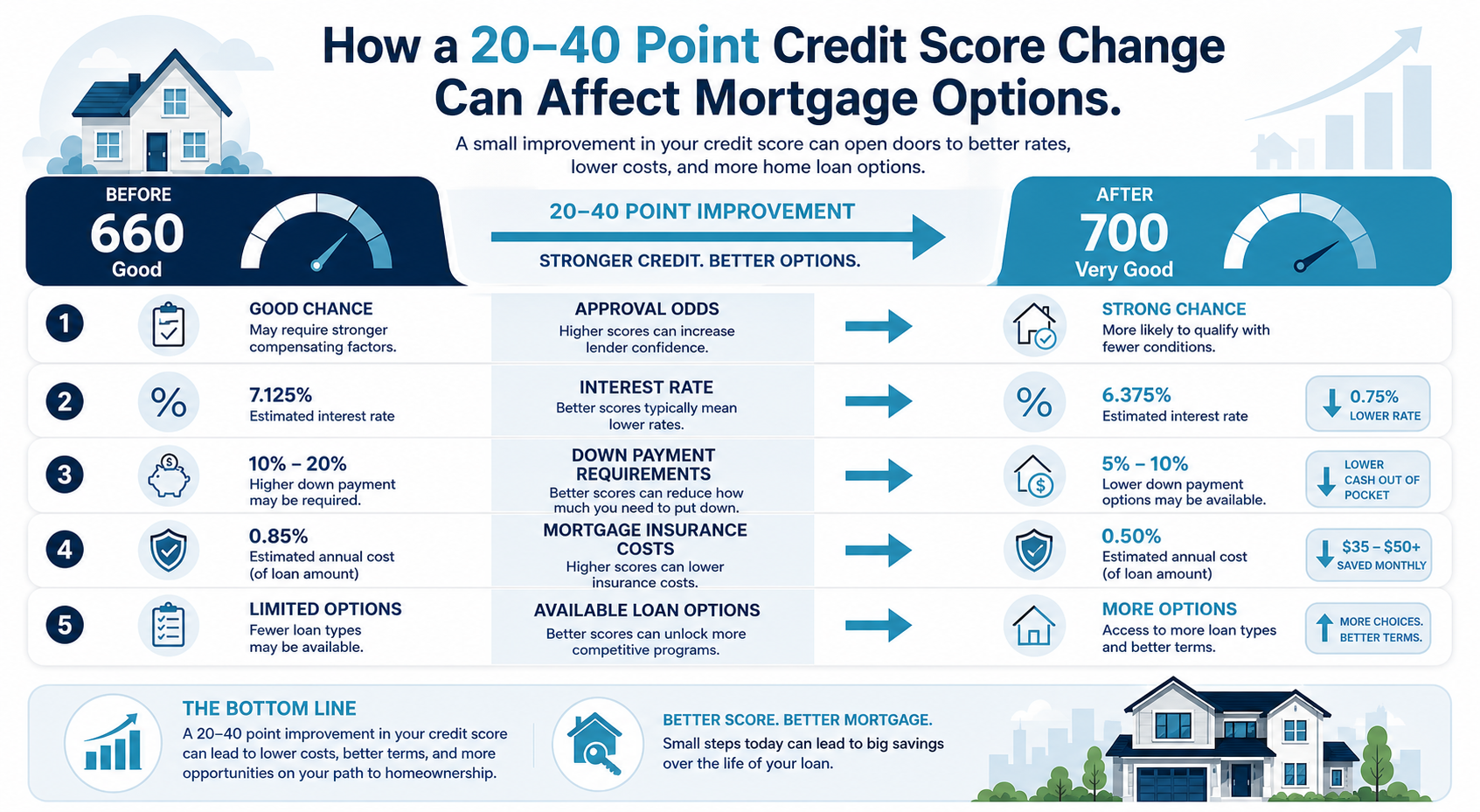
A Real Life Example: Using the VantageScore For a VA IRRRL


| Loan Product | FICO | VantageScore |
|---|
| Conventional Conforming | Yes | Yes |
| FHA Streamline | Yes | Yes |
| VA IRRRL / Streamline Programs | Yes | Yes |
| Conventional, FHA and VA Purchases | Yes | Yes |
| Jumbo Loans | Mostly FICO | Generally Not Standard Yet |
| Non-QM Loans | Mostly FICO | Generally Not Standard Yet |
Are There Risks to This Change?
At the same time, it is important not to oversimplify the benefit. Credit score is only one part of mortgage qualification. Income, assets, debt obligations, reserves, property type, and program rules still matter. For a broader look at 2026 mortgage-related changes, you can also read our 2026 housing update: loan limits, tax benefits, and policy changes.
There are also reasonable cautions. A higher qualifying score does not automatically mean a borrower is fully prepared for homeownership. Monthly affordability, cash reserves, employment stability, and overall financial readiness still matter.
Borrowers should view these scoring changes as an opportunity for better evaluation, not as a reason to ignore the bigger financial picture. The goal should be a mortgage that is not only approvable, but sustainable.
That is also why it helps to review more than just credit score before applying. For example, debt-to-income ratio can be just as important in many mortgage decisions. If you want a refresher, see our guide to what debt-to-income ratio (DTI) means for mortgage qualification.
The good news is that strong financial habits usually help both FICO and VantageScore. Paying bills on time remains one of the most important factors in either model. Reducing credit card balances and lowering utilization can also have a major impact. Avoiding too many new credit applications in a short period, maintaining older accounts when possible, and reviewing credit reports regularly for errors can all help strengthen a borrower’s profile.
Borrowers should also remember that preparing for a mortgage is different from casually monitoring credit. It helps to speak with a lender early, understand which scoring model may apply, and identify what changes would make the greatest difference before applying.
Final Thoughts
The growing use of VantageScore in mortgage lending may become one of the more important credit-related changes for borrowers in the years ahead. While FICO remains deeply established in mortgage underwriting, newer scoring models may help more borrowers qualify by recognizing credit strength in a broader and more current way
The biggest takeaway is simple: one credit score does not always tell the whole story. The right loan path may depend on how a borrower is evaluated, which lender is reviewing the file, and which guidelines apply. This matters for both homebuyers and homeowners looking to refinance
In the right scenario, a stronger eligible score may help support better pricing, stronger loan options, or a clearer path to approval. It is also important to understand that not every lender can offer this flexibility yet. Some lenders still rely on more limited scoring approaches, while others may not have access to the same range of eligible scoring options depending on the loan program and lending channel.
At Loandrone, we work with lenders that can compare eligible qualifying scores and use the stronger option when available under program guidelines. That can make a meaningful difference by improving approval strength, pricing, and overall financing options rather than forcing borrowers into a one-size-fits-all approach
This is especially important because this opportunity is now relevant across Conventional, VA, and FHA financing. That means the potential benefit may extend to:
- first-time buyers
- repeat buyers
- veterans and military families
- homeowners exploring rate-and-term refinances
- homeowners considering cash-out refinances